IM in text

It’s been a long time since I last started an operating system in text-mode only.
Even servers today have a GUI.

Anyway here it seems like someone needs to use instant messaging in text mode, which makes me think that the GUI is not available. Take a look at this summer of Code called gaim-text. It looks like the author really needed it to work on a terminal.
From the screenshots it seems like it actually works pretty well, with buddy list, message windows and so on.

Impressive work, I’d say!

OTA Firmware upgrade

I have always loved to have the most recent software version of everything.
I always check for updates and install the very latest betas. Sometimes is good, sometimes is not, if they are Beta there must be a reason!

I have to say that as a mobile phone fan I have always been a bit upset about the inability to update my phone or actually change the firmware version. For testing it is sometimes useful to be able to jump to a different firmware version.

I remember when Siemens first provided firmware upgrade softwares from their sites. It was the series 45 and a number of sites appeared with hacked upload softwares that let you change the firmware version and sometimes enable some debug features. It was a great time! I remember testing different versions, browsing sites to know the changelog and so on.

Siemens has been the only one to offer that service for quite some time and they actually removed it in subsequent families of devices.
Siemens was probably the only one that let you upgrade your firmware without wiping all your software. Nokia is famous for deleting all your contacts and calendars and settings when upgrading the firmware. Once it was not possible or very hard to keep the contacts syncronized with your computer and losing all of them would mean wasting a few hours to copy on paper and then insert in the new software version (not to mention possible mistakes!).

A few days ago I was browsing the Benq-Siemens site and discovered that they are supporting what they call S.O.A., an acronym for Software Over the Air.
On their website there’s a flash, you pick your phone and then you can download the software on your PC or directly on your phone, depends on the model.
This is GREAT! I WANT one.

Special thanks to Erik for a nice gift he sent me these days. In fact I just received a shiny new SE W810i!
To my surprise I discovered, while playing with it, that SonyEricsson offers the firmware upgrade too. You need to specify a connection profile, of course, it checks the central server and notifies you that a new firmware version is available. You are then allowed to download and install or postpone. In my case it was 1.4MB!
I decided to do with a USB cable actually, because I wanted to force the update for Italy instead of Norway. I still need to work on it, but I’m going to make it work. πŸ˜€

I wonder when will Nokia make it.

Mobile Phone renamed or bad copy & paste?

I was searching for the Samsung ZM60 and I found its page on Samsung’s UK site.

As I usually do while searching, I go on Google and open 2-3 tabs in the background and then scan page titles and read contents. In this case the page title tricked me, because the page clearly talks about the ZM60, but the page title and URL are for the Z300.

I wonder if the author used the Z300’s page and updated it or the device was renamed and they forgot to change the title. It looks like I can’t find an official page for it and review sites posted pictures that look a lot like the ZM60.

Opinions on the Mobile Web

The W3C and especially Tim Berners-Lee often talk about “One Web”.
It is great to hear them talking about the idea that the web should be only one and that everyone should be able to access the exact same contents indipendently from the language, region or medium used, wether he/she has any visual deficiency or any other handicap. We all wish for that to be true some day soon.

On the other side we, as developers, are facing problems to make this a reality. Someone believes that with a little extra effort we can do it well, someone else thinks that some barriers can not be passed so easily.

Barbara from Little Spring Design clearly states that the “Mobile Web” is not going to be part of the “One Web” anytime soon and provides a good number of reasons. She recently wrote an article named What’s wrong with the mobile web? (part 1).

Very interesting to read.

WURFL survey results

First of all thank you everybody for taking the time to answer our little survey. All the data that we have collected will help us to improve the project in the near future.

It was really flattering to see that more that 50% of the respondents think WURFL data deserves a 4 out of 5, 10% thinks it deserves a 5 and 30% a 3. This means that all respondents thinks WURFL is pretty good.
We know that in the mobile space there is a huge variety of devices, browsers and different capabilities, so not only is important quality, but also quantity. It seems like the respondents agree that we are covering most of their needs as the unsatisfied are just 5%, the remaining 95% is happy with what WURFL provides and 23% rate it 5.

It is interesting to note that most users download the official XML when it is released (54%), but then 41% of the users need to patch data with their own information. This means that probably WURFL could be updated more often and that these users should try to contribute more regularly with their data. In fact, from the open-ended answers, we can see that a lot of developers are too lazy or don’t know how to contribute. This is something that we can easily fix on our side providing better documentation about how to contribute and how contributions will be used, but we certainly need more support from developers that are doing their own device testing and being too lazy to send the data.

So, what are users doing with all this data? 91% of the respondents use the XML data, more than half uses the API’s that we provide and almost half of the users uses WALL (java 31%, PHP 16%).

And now the final question, who is using WURFL. Well, the bad news is that we can’t exactly say who is using it. The good is that the reason why we can’t say it is because everyone in the mobile ecosystem is using it, from site developers, to content aggregators, news sites, games developers (Java, BREW and online), and R&D divisions. It looks like WURFL is really covering all the bases.

You can download and see the full results here.

Apple’s iTV

Interesting article from Roughly Drafted about Apple’s iTV and specifically about the fact that strangely enough Apple has pre-announced a product that will be available in 4 to 6 months from now.

I agree with the idea that 802.11n is probably needed for the iTV to be successful, but I also think that it’s another way to let the majors know that Apple is serious about video downloads. It’s another way to say “Hey, you should join iTMS, because we’re going to broadcast your movies directly on TV, so call us if you want to be there”.

Pillager and Prey

About 3 months ago I received an unexpected present that was REALLY welcome.
I received a Dionaea Muscipula, probably the most famouse carnivorous plant after Audrey II.

In two words, the plant usually lives in swamps and is used to very poor water so you not should give it “normal” water, but only distilled or rain water. The plant will take the rest from the animals that it captures.

Initially I was really curious to see how it would do. After about a week I was concerned that it was not catching enough insects and bees. Then it started catching something, a mosquito, an ant, really tiny animals and insects.
Now about 3 months have passed and obviously these were the months in which nature is most active in Italy.

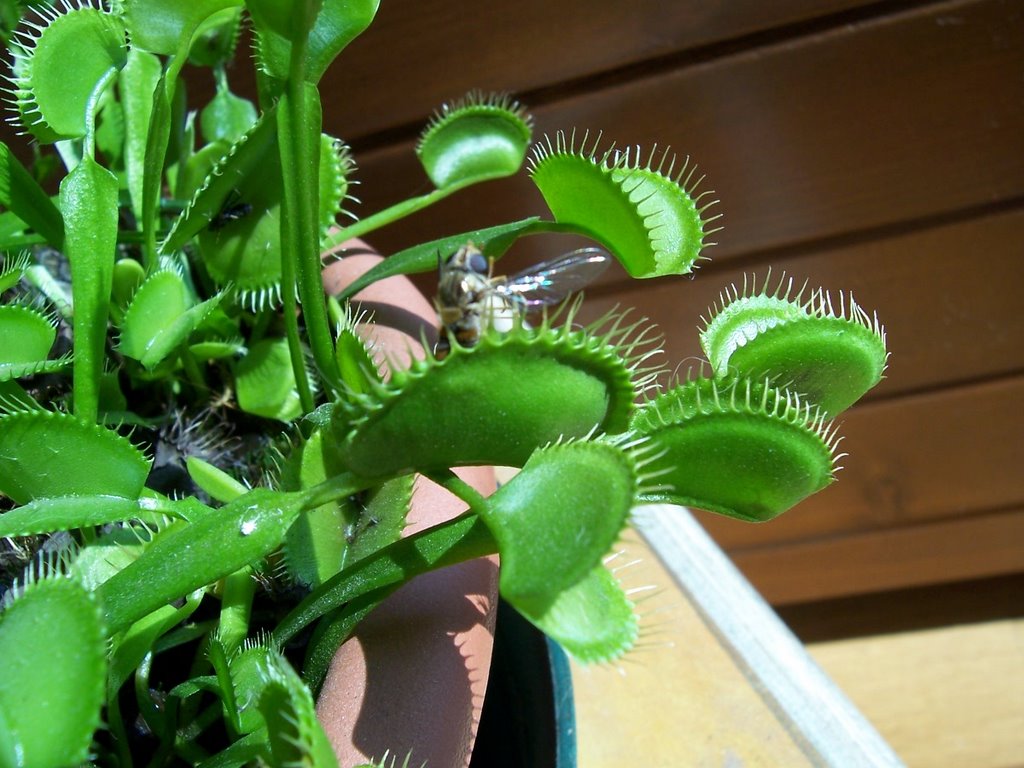
Here are a couple of pictures of an incredible catch from the plant. Obviously the bee was just about to escape, but could not make it.


In this picture you can see the plant from “far”, you can see the leaves which are actually the traps and in the center the poor bee that could not make it.
As you can see, most of the traps are open. They always stay open and close when something activates the sensors in the center of the leave. At that time the trap snaps close and hopefully catches the prey.

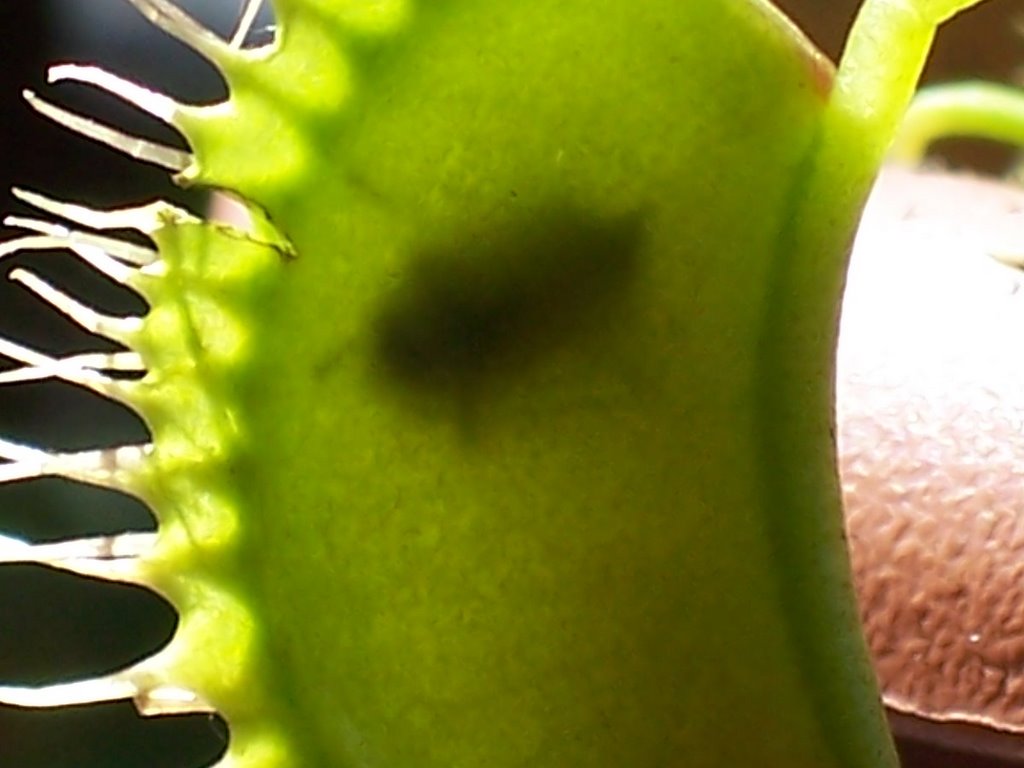
This is a zoom on the bee. As you can see only half of it was actually caught, but it has been enough for it to be trapped.

When the animal is trapped the plant secretes an enzyme that slowly eats it. After a few days the leave will return open and the little animal or insect is generally somehow “dried”, often looking squished. Once the leave is back open, it is ready to eat more.

Here is the last picture that I’m publishing. It was one of the first “big” preis and I was pretty amazed, unfortunately I could not see it, so I took this picture.