2009 (controversial) predictions

I think the first predictions for 2009 I’ve seen, at least related to the mobile space, were from Carlo Longino. After his predictions no other predictions I’ve seen so far are very interesting or are adding much value. Kudos to Carlo to be the first, sorry for the others who I think have wasted their time.

Of course, if you want to get your predictions right you have to stick to something very likely to happen and that will probably not appear SO interesting or will not surprising TOO many people. Challenged a bit by James Whatley (a.k.a. whatleydude) here I am wasting a bit of my time and trying to bring some more controversial and probably less likely to be accurate predictions. If I can get 1 right, I think I’ll be proud.

1. mobile/not-mobile becomes irrelevant
The line that separates a mobile phone from a PC is becoming thinner and thinner. We have mobile phones, smart phone, EEE PCs, laptops, notebooks and probably more I can’t think of and you can basically get ANY display size between 2″ to 19″ and put that piece of electronics in your pocket or your bag and also be connected at any time. The distinction between “desktop” and “mobile” is about to disappear.

2. Garmin for car-navigation becomes irrelevant
Garmin has been the leader in car-navigation for many years, their products were the best by far both from the perspective of accuracy and software bundled. Nevertheless Tom Tom in many countries like Italy is the synonym of “car-navigation”. Garmin for some reason could not make it (was it just marketing?) and now Nokia is seriously in the game and all other vendors are releasing at least some device with GPS (did anyone say Google Maps?), so any user who wants navigation, will have it in his mobile device. I am really sorry to say that Garmin has no hope (and Tom Tom will follow quickly or be acquired).

3. Microsoft gives up on licensing their mobile OS
I am not sure if Microsoft will start selling their own “Zune-phone”, even though I personally think it would be a failure, but I believe their OS itself has no hope and no reason to continue to exist, what Microsoft really needs is focus on licensing Active Sync and maybe a Mobile Office (If Google can’t get a proper mobile version of their online docs first). They will continue making money on what they are really good at and keep the dominance of the e-mail and contacts. Anyone who wants to compete with RIM will have to integrate that and pay the fee.

4. Motorola mobile devices division is acquired
Carlo bets on EITHER Motorola or Palm, so I’m aligning behind him, but with a clear bet on one.

5. eBay online auctions are either acquired or become irrelevant
I personally think eBay is really a poor site and it seems like they could not make any improvement in the last 10 years. They have been ignoring mobile so far and honestly I think they are making a huge mistake. More and more when I search for something all I see are ads. Paypal is a GREAT idea and Skype has killed any other VoIP service, but ebay… well…

SecurityFocus on mobile devices for the first time?

SecurityFocus Newsletter #485 is I think the first issue of the newsletter where mobile devices are listed. 2 issues have been reported one about the iPod Touch and iPhone and the other about the Nokia 6131, both are vulnerable to remote attacks on the browser.

The interest for security on mobile browsers is yet another proof that mobile is about to take over the rest of connected-electronics.


4. Nokia 6131 Multiple Vulnerabilities
BugTraq ID: 30716
Remote: Yes
Last Updated: 2009-01-05
Relevant URL: http://www.securityfocus.com/bid/30716
Summary:
Nokia 6131 is prone to multiple vulnerabilities.

The device is affected by URI-spoofing and denial-of-service issues.

Remote attackers may spoof the source URI of a site to direct users to a malicious location and trigger crashes in an affected device.


23. Apple iPhone and iPod Touch Prior to Version 2.0 Multiple Remote Vulnerabilities
BugTraq ID: 30186
Remote: Yes
Last Updated: 2009-01-05
Relevant URL: http://www.securityfocus.com/bid/30186
Summary:
Apple iPhone and iPod touch are prone to multiple remote vulnerabilities:

1. A vulnerability that may allow users to spoof websites.
2. An information-disclosure vulnerability.
3. A buffer-overflow vulnerability.
4. Two memory-corruption vulnerabilities.

Successfully exploiting these issues may allow attackers to execute arbitrary code, crash the affected application, obtain sensitive information, or direct unsuspecting victims to a spoofed site; other attacks are also possible.

These issues affect iPhone 1.0 through 1.1.4 and iPod touch 1.1 through 1.1.4.

Vodafone V640i with Netfront, one of the worst mobile browsing experiences

This summer I had the opportunity of getting a new phone for free (or for a small fee on some models) included in a new contract that dotMobi got for me. I thought it would be a good idea to get my hands on one of those phones that every normal customer get with their contract. Having loved my Sony Ericsson W810i I thought it would be wise to get another Sony Ericsson, so I chose the V640i, Vodafone exclusive. The phone is not exactly the lowest end on the market in fact it features a very good media player (including a good music player and playlist manager), bluetooth, stereo headphones included and a few more things. The camera is really cheap, very far from the now really old one included in my W810i. Per my personal tastes, the keys are a bit small and the green and red ones are too close to the accesskeys, but overall (and considering it was free) it’s a good phone and does all you would expect from a basic phone and more.

What I was most curious, of course, is the browser. The experience has been very poor and even if the device has the right accesskey configured to connect to Vodafone Live, the NetFront browser is really really bad. While the browser is capable of rendering WML, XHTML Basic and some basic HTML pages, I really do not see any reason why a user or customer would ever use this more than twice. I have a few screenshots that will prove my points, but let’s start saying that while I was browsing I often had no clue if the browser was retrieving content or not, in fact it was often stuck “loading”, but stopping and reloading the page would make it appear instantly, the browser really seems stalled from time to time. Initially I was in doubt if it was the phone, the network or the browser, but once I installed Opera Mini I was sure it was the browser.

My first test site is Metajam, a site about movies, TV shows and Music. I recommend that you click and see how the page is normally presented so that you get an idea. (Note: the side design has slightly changed since these screenshots were taken)

This is the first thing that I am presented when visiting the site:

At first I thought the site did not work on the V640i.

Clicking on the options accesskey (the left one), I see this item-list where the first item is “accept” (sorry for the poor quality):

I assume this does not tell anything to anyone, but to me, it immediately reminded of the form wizards in some WAP 1 browsers, so I clicked it (and wished I was not accepting something strange such as transferring 1 million dollars to a Nigerian bank).

This is what I saw once clicked, the real page body. Notice how each link is on an individual line, SO 1999:

Clicking again “options” and “accept” I get this very helpful page that I have no clue where it comes from and how it would be of any use:

Later I was looking for a mobie and did not want to browse movies by title, I rather wanted to search by keyword, but I could not find a search menu even though I knew on the iPhone version I had seen one! I took me quite a few pages before I thought about the “options” key. Again, “options” and “accept” was the unexpected solution. Here is another form wizard that you can see only using the “accept” menu. Clicking on the two square brakets opens a blank page where you can type the text and confirm and then be back here, not even automatically go to search.

Again very poor usability!

Enough with forms, let’s see how unordered lists look like. This time I am visiting ta-da.mobi, the test site of DeviceAtlas. Once logged in I go in the “Display” section to test the display size. As you can see the section has two tests and there is a bulleted list:

This is another page in TA-DA, with another bulleted list. The markup is EXACTLY the same, but we have no clue why the browser is displaying a broken image instead of the bullet:

If you are curious, this is the markup of the first page (the one that works):


And this is the code of the second page:

Again, the user will have no clue what’s happening and will think that this is a poor site that doesn’t even have the images in the right paths.

Browsing experience is really poor and some features such as landscape browsing are completely useless and the usability is even worse than with the normal browser. Developer efforts would have been better spent on making the browser work properly. 😉

On the bright side, Opera Mini 4.1 (I have not tested 4.2, yet) works like a charm, it is fast and reliable and both mobile and desktop sites work as expected. A must have for all V640i owners (and maybe all NetFront browser owners).

Apple Safari to support WML?

I was checking the latest changes of the webKit nightly to see if it’s worth updating my current nightly (about 1 month old) to something fresher. While looking at the timeline I noticed how a few commits have been made in the last few days to implement WML card, timer and do tags, some WMLScript and so on. BIG SURPRISE!

You can see for example a few changesets such as [38816], [38833], [38838] and a couple of bugs, #22522 and #22550.

I am definitely among those that think that WML is dead and that everything should be in XHTML by now and surely Apple as a company has been promoting the iPhone and the iPod touch as “full web” devices and in fact Safari Mobile does not even support HTML-MP. The addition of WML seems very strange to me.

OK, the main committer is not an Apple employee, but rather a KDE developer (Nikolas Zimmermann), but we all know that webKit is mostly controlled by Apple and if they are working on WML it means there is some interest. If they are working on WML, why not XHTML-MP?

We’ll see. I’ll keep an eye on this and definitely test a recent nightly!

New UI for search engines popping up

Just a couple of days I was searching on Yahoo! and noticed some special results for linkedin. See a search for my name:

Note the little icons on the right to get an explanation, send the link to a friend or stop getting this type of result.

And that made me think of some recent changes in Google search results when the page comes from a forum or a group. Here’s an example:

Note how you can see some details about the forum post, number of replies, etc.

This morning James pointed out how in Google a new interface has appeared and lets you add, edit or remove results. Here is how the interface looks for one result:

Depending on the position and result, the icons appear and disappear (you can’t promote to a higher position a result that is already at the top, of course) and also another icon to remove the result appears. At the bottom of the page a few interesting links appear showing you your previous actions and giving you the opportunity to revert your changes or update there. There’s also a link to learn more about SearchWiki. It would be interesting, and maybe it is already coming, to be able to mash up with results from people I know and trust. We’ll see.

After many years of minor tweaks to the Google UI that was replicated by most if not all search engines, we now see some innovation. It’ll be fun!

Can anyone catch up on Amazon’s cloud?

Cloud computing is the second buzz-word after social network these days. It’s all about storing or running your stuff “in the cloud”, remotely. If we all really used the cloud, a lot of storage and a lot of CPU power would be needed. Google has certainly created it’s own elastic cloud of computers and search and e-mail and other services proved how fast and reliable it is. But what about “the rest of us”? Amazon has been running storage (S3) and CPU (EC2) in the cloud for a long time now and even it is not known to the masses they are in fact providing the horse power to many start-ups. In their own words, “After two years in beta, Amazon EC2 has entered General Availability (GA)”.

I’ve had a chance to use S3 quite a bit and also EC2, a little bit. Both services are mostly for programmers, they are not really for the masses, but the solidity and the wide range of options is incredible. It was a surprise to see how well it works and how many things you can do very easily. Amazon provides a number of tools and the the community has also done its part and in fact there are some very interesting tools such as the Firefox plug-in elasticfox that make it super-easy to manage your servers.

From the beginning Amazon has been running Linux servers providing images that you could start with a click. Earlier this year they announced an agreement with Redhat that lets developers run Enterprise versions of Redhat linux.

A few days ago I was listening to the great podcast by the Guardian, Tech Weekly, it was the recording of Oct 28th. They spoke about the recently announced Microsoft Windows Azure and how this is a reply to Google’s and Amazon’s cloud computing solutions. Last week Amazon officially announced not only of being out of beta, but that Windows servers will now be available. It costs a slight bit more than running Linux, but of course you get the full Windows environment, including C# and you even have an option for Authentication services and SQL Server. This is AMAZING, you can get a Windows server up and running in seconds, do your development or tests and shut it down (very good if you need to test a specific version of Windows or combination of OS, Service Packs, etc). All this will cost less than a dollar.

Amazon EC2 is great both if you need to test something temporarily (start a server, test, shutdown) or if you want to run a service full time, in fact, EC2 you might easily run a limited number of servers normally, but when you have a peak start as many extra servers as you need.

Google has App Engine and while it is another approach to elastic computing it is quite different. Yes, it has some advantages such as that you just upload your code and it runs, but of course it does not give you the power and flexibility or a complete server at your fingertip.

I think it will be very hard for the other players to catch up and surely it will not be enough to throw in some money because Amazon already has a very good and most likely profitable business in place and they are not lacking the money themselves. It will be very interesting to see how this evolves and it will certainly be a a great opportunity to save on costs for small companies and start-ups.

EDIT: Did I mention that Amazon now guarantees 99.95% uptime? Can you think of any small to medium company that can seriously commit to such uptime?

UPDATE: Amazon has announced CloudFront a new file distribution system that reminds me a lot of Akamai.

Windows Mobile 6.5 and Zumobi

It looks like Microsoft has really picked up quite a bit from Zumobi for their next mobile OS.

On Techcrunch they have some screenshots that make it obvious. It will be interesting to see how the UI really works and if it’s any better than the one on current Windows Mobiles. The competition on UIs in mobile is now serious and I look forward to see if Nokia/Symbian will make the leap or will stay stuck on their existing UI (that seems a bit old to me).

PS: If you don’t find anything about a UI desgin on Zumobi, you might want to see this (now old) press release.

ESPN.mobi design

I started reading espn.mobi about a year ago and it used to be an LCD (lowest common denominator) approach for any device. A few months later they started offering a slightly better version for the iPhone and high-end devices, but really the main difference was that articles were not split into multiple pages.

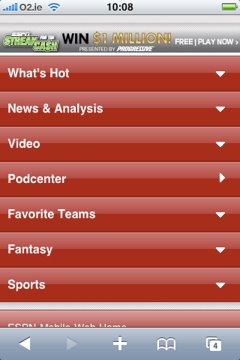
I haven’t used it much in the last couple of months and today I had a great surprise. Accessing with the iPhone I found a completely new and custom layout. The new layout is far from an LCD approach it is actually a very optimized design for the iPhone taking advantage of the AJAXy capabilities of the webKit, but also keeping in mind the iPhone input limitations providing big buttons for fat fingers.
The new homepage and then the pages inside are very colorful and the big (clickable) tabs give you immediately the opportunity to choose the section you are interested into.

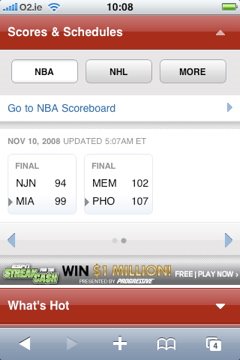
The design is (both in the iPhone and non-iPhone versions) focused entirely on the mobile context which is a proof ESPN understand mobile. From the very first moments you see the latest news and real-time scores. Again taking advantage of AJAX, scores are updated automatically every few seconds using a pseudo-ticker with nice little boxes with team names and scores. Very nice to the eye.

The non-iPhone version has also slightly improved from the version that has been available for a few months now.

The non-iPhone version is very light, but still very nice and is very usable on simple devices such as the Sony Ericsson V640.

Some more screenshots taken on my iPhone.

Real-time scores in nice boxes, scrollable sideways:

Latest news:

Section homepage (NBA in this case):

THUMBS UP TO ESPN!

PS: I know the layout of text and images isn’t perfect, but Blogger doesn’t let me do too much without breaking all the standard markup