Everyone wants an App Store these days

Apple has changed the world with the iPhone. Developers (and users sometimes) complained there were no open APIs to build native applications. Apple noted the request and changed the world again with the App Store.

Everyone in the mobile space seems to be running now to create his own store. Google has launched its store called Market (also see a short review with some nice screenshots) and while at this time it’s all free, it is going commercial next year.

RIM has its own BlackBerry Application StoreFront.

T-Mobile, who is already benefiting from Google’s Market, is going to create its own based on Apple’s experience.

Now Orange comes with Orange Downloads.

There are probably more that haven’t announced it, or simply I haven’t heard of.

BUT, did any of these guys ever think that the great thing about Apple’s App Store is that it is one place and there’s no fragmentation? How are these guys going to cope with this? Replicating and renaming won’t solve those issues. They will all be just like the existing “Decks” or portals, simply on a pre-installed application. That will not make them win.
Attacking Google where the money is

Google is undisputed leader of search. It’s useless for me to describe how Google changed the world about it, but let’s talk about everything else Google is doing such as documents, e-mail and mobile OS’s, of course. All this is funded by ads, while they have some other incomes such as former-Postini customers and other Google applications customers, ads are what fund anything Google do.

A few other companies tried to beat them starting from scratch such as cuil, but I would say that so far none of them has been able to be a serious competitor. Now what if the money on the ads was taken away from Google? If Google had to focus on ads more, would they be able to continue spinning off new applications and services? Would they still be able to create great apps and give them away as open-source just to kill the competition (think of Google docs and Android)? (OT: doesn’t this remind you of Microsoft and Netscape and other products they gave away embedded for free to kill the competition?)

It seems to me like recently the competition and innovation in ads have grown a lot. In mobile, Google is a follower and while they do have HUGE power and have been able to sign great contracts with operators and big players, the leader in mobile seems to be AdMob (even though I don’t have exact numbers handy). Now, also in web ads there is more and more competition. I was watching a video today about Dapper that is bringing some innovation with a product called Mashup ads. I am not a publisher, so I can hardly tell if this is a killer for Google, but surely it is something new and interesting.

High Efficiency

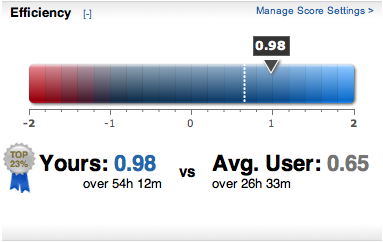
I always run Rescuetime in the background, even though I have to admit I don’t check it so often (anymore).
It was interesting to see that the week before the DeviceAtlas 2.0 release my efficiency was very high. See here:

It should be noted that normally during the day I spend some time developing and some time writing specs, talking to colleagues, on the phone and so on, but of course, just before the release it was all about development. 🙂

Within the DeviceAtlas team, on Monday 29th September, we worked an average of 11 hours and 30 minutes, plus the what the designers worked, that is probably about the same. What a team!!

Sony Ericsson X1 competition

This definitely the year of funding and competitions. There was the Android competition and then the 10M USD fund. There was the iFund for iPhone applications, there was the Blackberry Fund with a stunning 150M USD and now there’s yet another competition from Sony Ericsson. I got a message from David Cushman who claims to have a lead on this, see here: Sony-Ericsson X1 developer competition coming soon. The details are still lacking, but if you are a Windows (Mobile) developer you might consider this interesting, especially if you were wondering if it’s worth starting something.

For many years developers have been locked out of mobile devices, then J2ME came with its sandbox, it was better than nothing, but it was really limited. Over the years most of those limitation went away, but it looks like this is the year of the open development. So start coding, because mobile (web, J2ME and web applications) is where the is money for companies and developers!

Volantis Mobility Server 5.1

I’m pleased to see that Volantis Announces Mobility Server 5.1. According to the PR version 5.1 is focused around adding connectors for web 2.0 applications such as Picasa and Flickr. Also, the device database has been updated and they now claim more tha 5600 devices! I see that the open-source version of the server is still at 5.0, but I know they are really committed to open-source, so I’m sure they will follow up quickly. These days I’d be especially curious to see the Media Access Proxy in action, if done right it’s still one of the most important things in mobile (get the images right!).

They also announced an update to BuzzCast last week, hopefully my operator will buy it so that I can test it. 🙂 I’m a NetNewsWire addict, so BuzzCast seems quite interesting to me.

webKit the official mobile browser?

Initially Nokia announced the decision of using the webKit browser in their mobile devices in the S60 series and they called it S60 Browser (running on the S60WebKit). That was already a landmark, I think.

Apple of course boosted the users of webKit and Safari releasing the windows version of Safari and then Safari in the iPhone.

Google followed announcing webKit in Android and now with Chrome.

MOTOMAGX is a linux platform by Motorola. They use it for some of their PDA’s. The other day I received their newsletter that among the other things mentioned widgets for MOTOMAGX and guess what? The official browser is the webkit.

A lot of big companies are jumping on the webKit band-wagon, but I think my original question still stands, Will Apple share ownership of the webKit? It’ll be especially interesting to see how Google will contribute and try to take control of the platform as now they have a lot of interest in making sure it goes in the right direction. So far it looks like Nokia did not have much voice in the project, at least from what I see.

More open questions:

  • Where does this leave Opera (Mini)? Will there still be space for them?
  • What about the Mozilla’s Fennec mobile browser? If you want to know my opinion, they might be late to the party.
  • What about other browsers like Skyfire and Teashark?

Is transcoding a crime?

I was reading my RSS feed and of course this news item from TechCrunch caught my eye, Transcoding Is Not A Crime, Says Court In Veoh Porn Case (includes longer excerpt from the ruling and a video).

I was initially surprised that TechCrunch spoke about transcoders for mobile sites (remember Novarra, InfoGin, Openweb, etc?) and in fact they are talking about video and flash. The ruling is interesting and here is how it starts:

Here, Veoh has simply established a system whereby software automatically processes user-submitted content and recasts it in a format that is readily accessible to its users. Veoh preselects the software parameters for the process from a range of default values set by the thirdparty software.

The topic is very different, but if you read this text and applied it word-by-word to what proxy transcoders do, it would still make sense. So I wonder (and I’m not a lawyer by far), will this ruling also apply to mobile proxies?

DISCLAIMER: I agree this is extreme, but not entirely impossible.