Apple Safari to support WML?

I was checking the latest changes of the webKit nightly to see if it’s worth updating my current nightly (about 1 month old) to something fresher. While looking at the timeline I noticed how a few commits have been made in the last few days to implement WML card, timer and do tags, some WMLScript and so on. BIG SURPRISE!

You can see for example a few changesets such as [38816], [38833], [38838] and a couple of bugs, #22522 and #22550.

I am definitely among those that think that WML is dead and that everything should be in XHTML by now and surely Apple as a company has been promoting the iPhone and the iPod touch as “full web” devices and in fact Safari Mobile does not even support HTML-MP. The addition of WML seems very strange to me.

OK, the main committer is not an Apple employee, but rather a KDE developer (Nikolas Zimmermann), but we all know that webKit is mostly controlled by Apple and if they are working on WML it means there is some interest. If they are working on WML, why not XHTML-MP?

We’ll see. I’ll keep an eye on this and definitely test a recent nightly!

ESPN.mobi design

I started reading espn.mobi about a year ago and it used to be an LCD (lowest common denominator) approach for any device. A few months later they started offering a slightly better version for the iPhone and high-end devices, but really the main difference was that articles were not split into multiple pages.

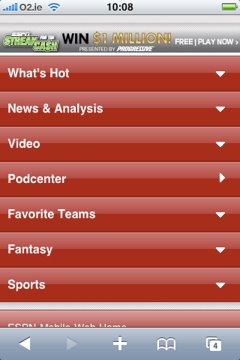
I haven’t used it much in the last couple of months and today I had a great surprise. Accessing with the iPhone I found a completely new and custom layout. The new layout is far from an LCD approach it is actually a very optimized design for the iPhone taking advantage of the AJAXy capabilities of the webKit, but also keeping in mind the iPhone input limitations providing big buttons for fat fingers.
The new homepage and then the pages inside are very colorful and the big (clickable) tabs give you immediately the opportunity to choose the section you are interested into.

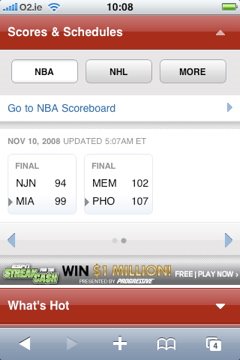
The design is (both in the iPhone and non-iPhone versions) focused entirely on the mobile context which is a proof ESPN understand mobile. From the very first moments you see the latest news and real-time scores. Again taking advantage of AJAX, scores are updated automatically every few seconds using a pseudo-ticker with nice little boxes with team names and scores. Very nice to the eye.

The non-iPhone version has also slightly improved from the version that has been available for a few months now.

The non-iPhone version is very light, but still very nice and is very usable on simple devices such as the Sony Ericsson V640.

Some more screenshots taken on my iPhone.

Real-time scores in nice boxes, scrollable sideways:

Latest news:

Section homepage (NBA in this case):

THUMBS UP TO ESPN!

PS: I know the layout of text and images isn’t perfect, but Blogger doesn’t let me do too much without breaking all the standard markup

Volantis Mobility Server 5.1

I’m pleased to see that Volantis Announces Mobility Server 5.1. According to the PR version 5.1 is focused around adding connectors for web 2.0 applications such as Picasa and Flickr. Also, the device database has been updated and they now claim more tha 5600 devices! I see that the open-source version of the server is still at 5.0, but I know they are really committed to open-source, so I’m sure they will follow up quickly. These days I’d be especially curious to see the Media Access Proxy in action, if done right it’s still one of the most important things in mobile (get the images right!).

They also announced an update to BuzzCast last week, hopefully my operator will buy it so that I can test it. 🙂 I’m a NetNewsWire addict, so BuzzCast seems quite interesting to me.

webKit the official mobile browser?

Initially Nokia announced the decision of using the webKit browser in their mobile devices in the S60 series and they called it S60 Browser (running on the S60WebKit). That was already a landmark, I think.

Apple of course boosted the users of webKit and Safari releasing the windows version of Safari and then Safari in the iPhone.

Google followed announcing webKit in Android and now with Chrome.

MOTOMAGX is a linux platform by Motorola. They use it for some of their PDA’s. The other day I received their newsletter that among the other things mentioned widgets for MOTOMAGX and guess what? The official browser is the webkit.

A lot of big companies are jumping on the webKit band-wagon, but I think my original question still stands, Will Apple share ownership of the webKit? It’ll be especially interesting to see how Google will contribute and try to take control of the platform as now they have a lot of interest in making sure it goes in the right direction. So far it looks like Nokia did not have much voice in the project, at least from what I see.

More open questions:

  • Where does this leave Opera (Mini)? Will there still be space for them?
  • What about the Mozilla’s Fennec mobile browser? If you want to know my opinion, they might be late to the party.
  • What about other browsers like Skyfire and Teashark?

Is transcoding a crime?

I was reading my RSS feed and of course this news item from TechCrunch caught my eye, Transcoding Is Not A Crime, Says Court In Veoh Porn Case (includes longer excerpt from the ruling and a video).

I was initially surprised that TechCrunch spoke about transcoders for mobile sites (remember Novarra, InfoGin, Openweb, etc?) and in fact they are talking about video and flash. The ruling is interesting and here is how it starts:

Here, Veoh has simply established a system whereby software automatically processes user-submitted content and recasts it in a format that is readily accessible to its users. Veoh preselects the software parameters for the process from a range of default values set by the thirdparty software.

The topic is very different, but if you read this text and applied it word-by-word to what proxy transcoders do, it would still make sense. So I wonder (and I’m not a lawyer by far), will this ruling also apply to mobile proxies?

DISCLAIMER: I agree this is extreme, but not entirely impossible.

US Smartphone users browse twice the British ones

According to M:Metrics US owners of smartphones (can someone tell me exactly what a smartphone is?) browse the web twice as much as British users.

It is obvious that users who bought a smartphone will make a use that is different from users who bought a cheap mobile device. I always thought Britain was one of the most active countries in this space, anyway.

Interesting how the only site in common is Facebook. No wonder they did an iPhone UI and are getting more active in the mobile space.
No Google? Only live.com? No eBay in Britain?

These are the numbers coming straight from M:Metrics.

Top Domains by Time Spent Browsing per Month: United Kingdom

Domain Company Total
Total Total 2:24:58
facebook.com TheFacebook, Inc 1:44:47
three.co.uk Hutchison Whampoa Limited 1:30:51
sky.com British Sky Broadcasting Group Plc 1:15:28
live.com Microsoft Corporation 1:11:06
bbc.co.uk British Broadcasting Corporation (BBC) 0:48:10

Top Domains by Time Spent Browsing per Month: United States

Domain Company Total
Total Total 4:37:48
craigslist.org Craigslist, Inc. 1:38:51
ebay.com eBay Inc. 1:25:41
myspace.com News Corporation 1:25:13
facebook.com TheFacebook, Inc 1:24:09
go.com The Walt Disney Company 1:07:04

Also, Mark Donovan, senior analyst, says:

People are becoming increasingly engaged in the mobile medium. Among smartphone users in the United States, mobile browsing has increased 89 percent year over year, and pageviews have increased 127 percent. Consumption is quickly evolving from brief transactions, such as checking the weather or flight status, to time-intensive interaction with mobile Web sites—even without an iPhone.

And Paul Goode, senior analyst, adds:

A primary factor in the discrepancy in the duration of time spent browsing between British and American smartphone users is the relative popularity of flat-rate data plans in the United States, where 10.9 percent of users have an unlimited data plan versus only 2.3 percent in Britain. Other factors to consider are the popularity of devices with QWERTY keyboards in the United States—where nine of the ten top smartphones are QWERTY, while the inverse is true in the UK–and the greater penetration of smartphones in the British market.


Flash, Flashlite, SVG and Java

Flash is a huge success on the web. It’s been like that for a long time now.

SVG is a recommendation (read standard) by the W3C that should address some of the functionalities of Flash.

While Flash Lite has been very successful in Japan for many years (and I think simply because DoCoMo decided it would be the default on all devices), it has struggled in the rest of the world.

In the last couple of years Nokia, Sony Ericsson and other top vendors have more or less quietly implemented SVG Tiny (a subset of SVG for mobile devices). From my perspective it seemed like SVG would take over Flash (Lite) in the mobile space, but it looks Adobe is moving to make sure this does not happen.

A few news that I’ve read in the last couple of weeks, all within just a few days:

dotMobi acquires Mowser

The word is out, dotMobi has acquired IP from Mowser and will now be in charge of running the service.

There’s not much I can say that hasn’t been said already. James over Twitter, Miker, Russell.

I am mostly curious about what will the community say. It’s a bold move for a company that has been advocating “Build for mobile” for years while Mowser seems to come from the opposite direction. I think we have some strong ideas about how to use Mowser at best and you’ll see it happening quickly.

Working with Mike and Russell is going to be exciting (except Russell is not in Ireland, but I’m used to working long-distance!).